

WASHINGTON, April 5, 2026 — In what President Donald Trump is calling one of the most daring rescue operations in American military history, U.S. special forces successfully extracted a wounded Air Force colonel from deep inside the mountains of Iran early Sunday morning, after the officer spent more than a day evading capture behind enemy lines.
The missing crew member was recovered in a complex operation that involved dozens of special forces personnel and several dozen warplanes and helicopters.
Trump confirmed the rescue on Truth Social, describing it as “one of the most daring search and rescue operations in U.S. history,” and said the officer “sustained injuries but will be just fine.”
The Shootdown
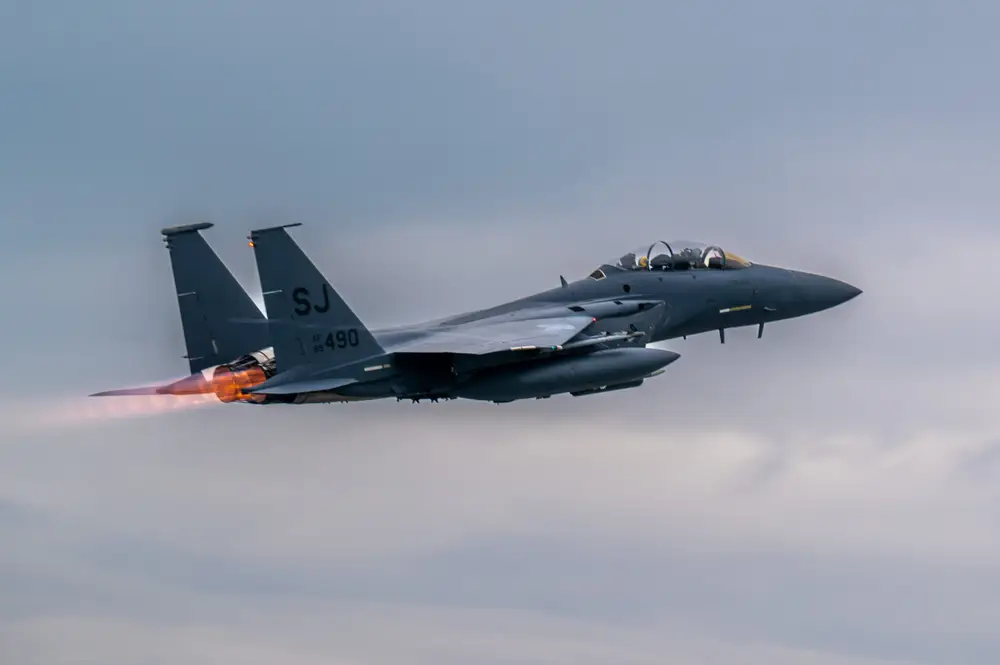
The officer was one of two crew members aboard an F-15E fighter jet that was shot down over a remote area of Iran on Friday. Iranian Revolutionary Guards took credit for the strike, alleging the jet was brought down in southwestern Iran. The jet’s pilot was safely ejected and rescued by two military helicopters, but the second crew member — a weapons systems officer — had remained missing.
Evading Capture Alone
Hiding alone in a mountain crevice behind enemy lines, the injured airman worked to survive and evade for more than a day, scaling rugged terrain to a ridgeline 7,000 feet above sea level, equipped with little more than a pistol, a communication device, and a tracking beacon.
The U.S. and Iran were effectively racing to find the airman, with Tehran calling on the public to hand over the soldier to authorities in what appeared to be attempts to capture an American prisoner of war, as the U.S.-Israel war on Iran entered its 37th day.
A CIA Deception and a Daring Extraction
The CIA was deeply involved in the rescue mission. Prior to locating the airman, the agency launched a deception campaign, spreading word inside Iran that U.S. forces had already found him and were moving him on the ground for exfiltration. While the deception was ongoing, the CIA used its capabilities to track the crew member and shared his exact location with the Pentagon and the White House, after which the president ordered an immediate rescue mission.
As American special operations forces converged on the mountainside, U.S. planes conducted strikes in the area to prevent Iranian forces from reaching him first. Two MC-130J special operations transport aircraft that had been waiting at a remote airstrip inside Iran were damaged during the operation; the military decided to destroy them rather than risk them falling into Iranian hands.
The three rescue planes ultimately flew out of Iran to Kuwait, each just a short distance behind the other. The mission was completed just before midnight, with all U.S. forces out of enemy airspace. CBS News
A Heavy Firefight
Although intended as a swift night extraction, the operation dragged into daylight hours as enemy fire prolonged the mission. Al Jazeera’s reporter described what officials characterized as a “heavy firefight” as U.S. forces closed in on the airman.
Three rescue aircraft flying at low altitudes were hit by Iranian fire. One, an A-10 Warthog, was struck but its pilot managed to keep flying until reaching Kuwaiti airspace, where he ejected and was recovered safely.
International Reaction
Israeli Prime Minister Benjamin Netanyahu hailed the rescue as an “incredible” operation, saying it proved that “when free societies muster their courage and their resolve, they can confront seemingly insurmountable odds.” Israel had postponed some planned strikes in Iran to avoid interference with the search and rescue efforts and provided intelligence support to the mission.
Iran’s state media sought to undercut the announcement, with one outlet claiming that “several enemy American aircraft were destroyed by the warriors of Islam, and the pilot rescue operation failed.” Iran’s military has not confirmed the rescue.
What Comes Next
Trump said he would hold a news conference at the White House on Monday to speak further about the operation. Separately, he threatened Iran with devastating strikes on its power plants and bridges if the country does not reopen the Strait of Hormuz, which has been blocked for weeks amid the ongoing conflict, warning of consequences by Tuesday.

